Metrology

Power PMAC motion control for Metrology and Inspection Systems Scanning motion, position-based triggering and error compensation for CMMs, profilometers, interferometers and inspection systems.
Hardware position capture and compare · 3D cross-axis compensation in the servo loop · Servo-rate data gathering on any variable
Faraday Motion Controls build bespoke motion control solutions for metrology and inspection equipment, based on the OMRON Power PMAC platform. This field demands the same core capabilities: smooth, constant-velocity scanning, precise synchronization between axis position and sensor data, and reliable correction for known machine geometry errors.
Coordinate measuring machines.
Bridge, gantry and cantilever configurations with scanning and touch-trigger probing. Probe position is captured in hardware when the trigger signal occurs, removing software latency from the recorded point. Volumetric compensation tables correct machine geometry across the working volume, and dual-loop feedback allows position to be closed on a scale while velocity is closed on the motor.
Surface profilometry and roughness measurement.
Constant-velocity scanning with low velocity ripple. Compare outputs clock the gauge at fixed spatial intervals rather than fixed time intervals, giving even spatial sampling independent of axis velocity variation.
Optical and interferometric inspection.
Analogue interferometer feedback and 1 Vpp sinusoidal encoders with high interpolation, feeding a servo loop updating at up to 25 μs. Focus, tip-tilt and rotary axes are coordinated within the same controller.
Wafer, mask and display inspection.
Raster scanning with camera triggering from position hardware. Compare points can be auto-incremented across a scan, so a single move produces a defined sequence of exposures without host intervention.
Rotary and form metrology.
Roundness, gear and thread measurement requiring a fixed relationship between rotary and linear axes. Electronic gearing and camming are handled by the trajectory planner; other relationships can be defined as kinematic routines.
Non-contact and X-ray systems.
Sample manipulators and CT rotary stages where projection angle must be known accurately. Position-based triggering and hardware capture provide this directly.
Position capture and compare circuits operate in hardware, independently of software execution timing. Compensation is applied inside the servo loop and includes leadscrew and backlash correction for single axes, and two- and three-dimensional cross-axis tables for straightness, squareness and Abbe error across the volume.
The trajectory planner supports spline and PVT interpolation through large point sets, S-curve profiles and jerk limits, which matters where scan smoothness affects the measurement itself.
Servo-rate data gathering records commanded position, following error, torque, encoder values and analogue inputs for analysis during commissioning or fault investigation.

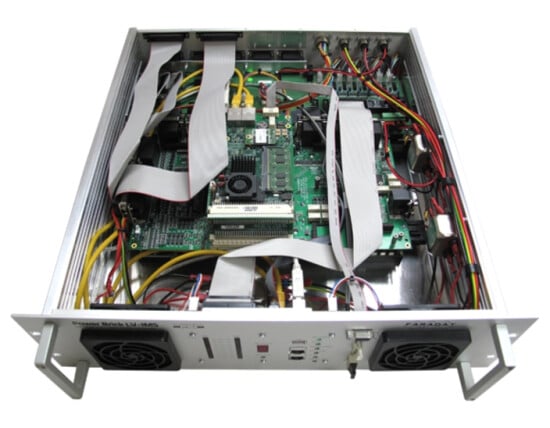
CK3M with axis interface modules matched to the feedback in use covers most metrology systems. Power Brick LV suits low-voltage stages where integrating the drives reduces cabinet size and wiring. Power UMAC is used for larger installations with high axis counts or distributed I/O. All share the Power PMAC IDE, which includes an offline simulator for developing and testing control code before hardware is available.
Discuss a project
Send us the machine specification or the control requirement and we will advise on whether Power PMAC is a suitable platform, and what hardware configuration it would need.