ADAS and autonomous vehicles

Power PMAC Motion Control for ADAS and AV Position-triggered capture, sensor calibration, HIL benches, target positioning and camera alignment.
Position-triggered sensor capture · All axes on one trajectory clock · Real-time algorithm execution on the controller
Sensor test and calibration require target position and sensor capture to be related accurately in time. Power PMAC handles both the positioning and the triggering, with compare and capture functions implemented in hardware rather than in software.
End-of-line sensor calibration.
Camera, radar and lidar calibration stations in vehicle assembly, positioning target boards and reflectors repeatably within a fixed cycle time. Settle behaviour and repeatability are usually the limiting factors, rather than move speed.
Camera module active alignment.
Multi-axis alignment of lens to sensor, closing on image quality feedback. The search algorithm is written in C and executed on the controller, so each iteration occurs within the real-time loop.
Radar target simulation and antenna positioning.
Pan-tilt and linear positioners placing antennas or targets at defined angles and ranges, synchronised with the simulator's timing.
Lidar test and scanner control.
Constant-velocity rotating and oscillating mirror control with velocity regulation, and positioners for characterising range, reflectivity and angular resolution across the field of view.
Hardware-in-the-loop benches.
Motion axes representing steering, target motion or sensor pose, driven from a simulation environment at a deterministic update rate.
Target movers and gantries.
Overhead and floor-mounted systems moving pedestrian, cyclist and vehicle targets through scripted trajectories, with multiple axes coordinated on a common time base.
Environmental testing.
Positioners operating across temperature and humidity ranges, with compensation applied for thermal drift where the structure requires it.
Compare outputs generate a trigger at a defined commanded position, and capture inputs latch actual position when an external signal occurs. Both operate in hardware, so the relationship between position and sensor capture does not depend on software execution timing.
All axes on a controller are planned by one trajectory engine on one clock, so target motion and sensor pointing remain coordinated without correcting for drift between subsystems.
The controller runs a real-time Linux system, supporting on-board logging and algorithm execution in C, with EtherNet/IP, OPC UA and MQTT available on current firmware revisions for integration with wider test infrastructure.
Hardware
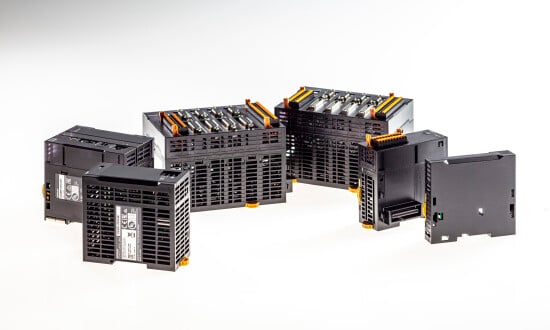
CK3E can act as the motion master where an existing test system is already EtherCAT-based, with up to 32 axes of EtherCAT control.
CK3M and Power Brick LV suit bench and alignment systems, including the low-voltage servo and voice coil actuators commonly used in fine alignment. Larger test cells, gantries and multi-station lines use Power UMAC or CK3M with EtherCAT distribution.
Discuss a project
Send us the machine specification or the control requirement and we will advise on whether Power PMAC is a suitable platform, and what hardware configuration it would need.